This month there has been a lot of resin going on! And we are not the only ones, resin is trending all over the craft world.
What is resin anyway? Basically, it's a plastic. It's a special plastic that is very hard and clear when it has cured. Resin is fun because it becomes very glass-like. More specific abilities of resin depends on the brand you are using. If you have tried it in the past and been frustrated, it's worth going back to.
Diamond Glaze, Glossy Accents, and a few others have some great shiny effects for paper crafting. They are ready straight out of the bottle and air dry. So why use a two part product that requires mixing and curing time? Resin has the ability to cover a large surface very quickly and much more economically. I have never seen Tim Holtz (who one cannot help but adore) filling up his shadow boxes with glossy accents.
This was from my most recent post, but I did not bring this up to imply anything against Tim. I bring it up because I did try to coat a tray with Glossy Accents. Actually two trays, for two beloved family members. The compartments turned uneven and warped. I can hardly stand to look at it now, it's such a mess.
At the time of my tray disaster, I did not know about self-leveling, doaming, or the role of surface tension. The paper crafting products I used had high surface tension (the characteristic that causes water to form in droplets) and so did not even out (or level). Resin will level out as far as it can when you have first mixed it before curing starts. This is why you can easily get a smooth glassy surface in those jewelry settings (usually bezels).
The other resin ability is that we can cast with it! Casting is pouring a material into a open form that will later solidify. I worked in a jewelry store's customer service area after college, and in the shop the jewelers would cast in gold and white gold every week. At the shop you see "Clear Cast" which is the clear resin. Amazing Crafting Products also makes a white casting resin. Have you see Prima or Melissa Francis's frames, butterflies, and other white embellishments? They are resin, probably a white resin.
There is one other piece you need to start casting, a mold. Amazing Crafting Products makes two types of mold making ingredients, molding putty and rubber molds. The putty is very easy, clean and quick. Mix it together and use a small object to create an imprint, and when it is no longer squishy, you have a mold. The rubber mold needs a container you can pour it into to set. However the cured mold is really flexible and surprised me with its ability to mold intricate forms. Don't forget there are finished molds you can pick up in your craft store if you would like.
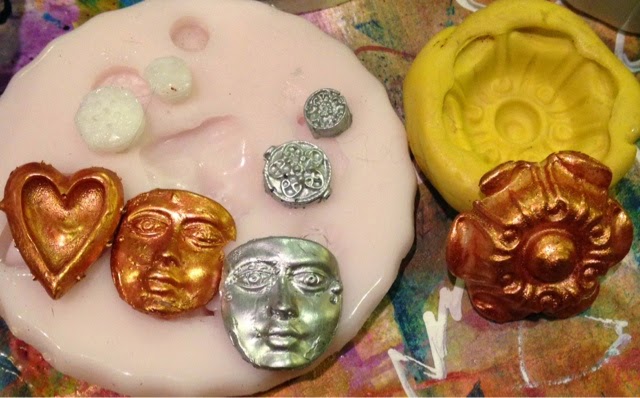
I cast with a rubber mold, a putty mold and a polymer clay texture sheet for my recent project. Pictures, fianlly!
Rubber and putty molds, all objects are the cast pieces not originals.
Martha Stewart mold with some Pearl powder from ACP dusted on before the pour.
A mold set by Mod Podge that I dusted with metallic powder
A texture mat by Lisa Pavelka for her favorite medium, polymer clay. Even these thin little gears held up.
Here are some casts and the originals
The casts come out clear or white, depending on what you use. I painted mine with Viva's Precious Metals Effects paint because it is fast drying. I'm confident Pinata paint or alcohol inkers will also work. This mostly applies to castings in the rubber mold because it creates a smooth surface that may not be good for water color and some acrylics paints.
Now see the cast pieces in my project close-ups.
If you have had the patience to read this whole post, then I think you will be better prepared of what you can expect from resin! One final and really important tip: read the instructions! Prepare the things you are working on and pay attention to stirring time, the time you have before it starts hardening and how long to leave alone to do its thing.
And it's only half way through the month! Enjoy resin! -heather